Define Serial Tendering
IDEA (2008) defines completing the tendering process electronically (e-procurement) as “an electronic tendering solution that facilitates the complete tendering process from the advertising of the requirement through to the placing of the contract.” Electronic. Stage or two stage process. It also incorporates serial tendering. A ship's tender, usually referred to as a tender, is a boat, or a larger ship used to service or support other boats or ships, generally by transporting people or supplies to and from shore or another ship.
A ship's tender, usually referred to as a tender, is a boat, or a larger ship used to service or support other boats or ships, generally by transporting people or supplies to and from shore or another ship. Smaller boats may also have tenders, usually called dinghies.
Overview[edit]
For a variety of reasons, it is not always advisable to try to tie a ship up at a dock; the weather or the sea might be rough, the time might be short, or the ship too large to fit. In such cases tenders provide the link from ship to shore, and may have a very busy schedule of back-and-forth trips while the ship is in port.
On cruise ships, lifeboat tenders do double duty, serving as tenders in day-to-day activities, but fully equipped to act as lifeboats in an emergency. They are generally carried on davits just above the promenade deck, and may at first glance appear to be regular lifeboats; but they are usually larger and better-equipped. Current lifeboat tender designs favor catamaran models, since they are less likely to roll in the calm to moderate conditions in which tenders are usually used. They typically carry up to 100 to 150 passengers and two to three crew members.
Before these ships were mass-produced, the main way to board a larger ship (mainly ocean liners) was to board a passenger tender. Passenger tenders remained based at their ports of registry, and when a ship came through the area, the tender would tie up with the ship and embark passengers on an elevated walkway. These vessels were larger, had a greater passenger capacity, and a broader sense of individuality in their respective companies than the more modern tenders seen today. Because of their increased size, lifeboats and life preservers were commonplace on board these ships (with two boats being the standard amount for an average tender).
History[edit]
Before the technologies that allow submarines and destroyers to operate independently matured by the latter half of the 20th century (and significantly during the Second World War), they were heavily dependent upon tenders to perform most maintenance and supply. Their hull classification symbols in the US Navy were, respectively, AS and AD, while general repair ships were AR. Naval tenders fell out of use during the late 20th century, as the speed and range of warships increased (reducing the need for advanced basing).
By the end of the 20th century, all of the tenders in the U.S. Navy had been inactivated except for two submarine tenders. As a result of the settlement of lawsuits over the Suisun Bay Reserve Fleet, the U.S. Navy and MARAD are engaged in an aggressive disposal program that will scrap all of those ships by 2017. While the Navy's plans for tenders held in reserve in other places (such as inactivated submarine tenders USS McKee and USS Simon Lake held at Inactive Ships, St. Juliens Creek Annex) were not addressed in that lawsuit, since its settlement, the Navy has indicated its desire to dispose of such ships as soon as possible[citation needed].
Apparently not completely willing to wean itself from tenders all together – but with an eye towards reducing costs – the last two tenders remaining in active service have now been operationally turned over to the Military Sealift Command. Emory S. Land-class submarine tendersUSS Emory S. Land and USS Frank Cable are now manned and operated by a 'hybrid' crew. The Captain and a couple hundred technicians are regular Navy; while the operation of the ship itself is performed by Merchant Marines. Prior to the turn-over, both ships had more than 1000 sailors. While at this time the ships still bear the AS classification, both ship's primary mission has been expanded well beyond submarines to include service and support of any Naval vessel in their operational area. Under the traditional Navy classification, both ships should be reclassified as AR (Auxiliary Repair), however since now operated by the MSC it is doubtful such a reassignment will occur. Emory S. Land is forward deployed in the Indian Ocean at Diego Garcia while Frank Cable is forward-deployed in the Pacific at Polaris Point, Apra Harbor, Guam. Such forward deployments are to provide service and support at the very great distances of the Western Pacific.[1]
Two tenders, SS Nomadic and SS Traffic, were built for the White Star Line by Harland and Wolff to serve the liners RMS Olympic and RMS Titanic at Cherbourg. Nomadic survives as a museum ship, and is the last remaining vessel built for the White Star Line in existence.[2]
Other types of tenders[edit]
- Armed tender, 19th century British supply or transport ships that were outfitted and commissioned for military use in the Naval Service.[3]
- Buoy tender, used to maintain navigational aids.
- Cannery tender, a type of commercial fishing vessel of the first half of the 20th century used to set up and maintain fish traps, transport fish from the traps to salmon canneries, patrol to prevent theft of fish from the traps, and transport personnel and supplies for salmon canneries.
- Destroyer tender, a large ship used to support a flotilla of destroyers or other small warships.
- Dive tender, a ship or boat used to support the actions of divers. Also known as a diving support vessel.
- Fish tender, a vessel that commercially supplies, stores, refrigerates, or transports fish, fish products, or materials directly related to fishing or the preparation of fish to or from a fishing, fish processing, or fish tender vessel or a fish processing facility.[4]
- Lighthouse tender, used to tend lighthouses, lightvessels, and, later, buoys.
- Mail tender, a small tender used to speed the delivery of mail from large liners
- Motor torpedo boat tender, a mobile base and supply ship used to support motor torpedo boats on operations during World War II.
- Pribilof tender, a term used for United States Government-owned and -operated cargo liners that provided transportation to, from, and between the Pribilof Islands from 1917 to 1975
- Seaplane tender, either a ship carrying multiple seaplanes, also known as a seaplane carrier, and considered to be a predecessor to the aircraft carrier; or a small craft used to support the operations of flying boats.
- Submarine tender, a large ship used to support a flotilla of submarines.
- Torpedo boat tender, a ship used during the late 19th and early 20th centuries to carry torpedo boats to sea and deploy them against enemy ships
- Yacht tender, a craft that services an anchored or moored yacht
See also[edit]
References[edit]
| Wikimedia Commons has media related to Ship's tenders. |
- ^TenderTale News
- ^Nomadic Preservation SocietyArchived 2009-04-03 at the Wayback Machine
- ^Barnes, F.K. (1888). 'Section II'. Brassey's Annual; the Armed Forces Year-book. Portsmouth, UK: Griffin & Company. p. 66.
- ^uslegal.com Fish Tender Vessel Law and Legal Definition Retrieved December 5, 2018
Disclaimer: This work has been submitted by a student. This is not an example of the work produced by our Essay Writing Service. You can view samples of our professional work here.
Any opinions, findings, conclusions or recommendations expressed in this material are those of the authors and do not necessarily reflect the views of UK Essays.
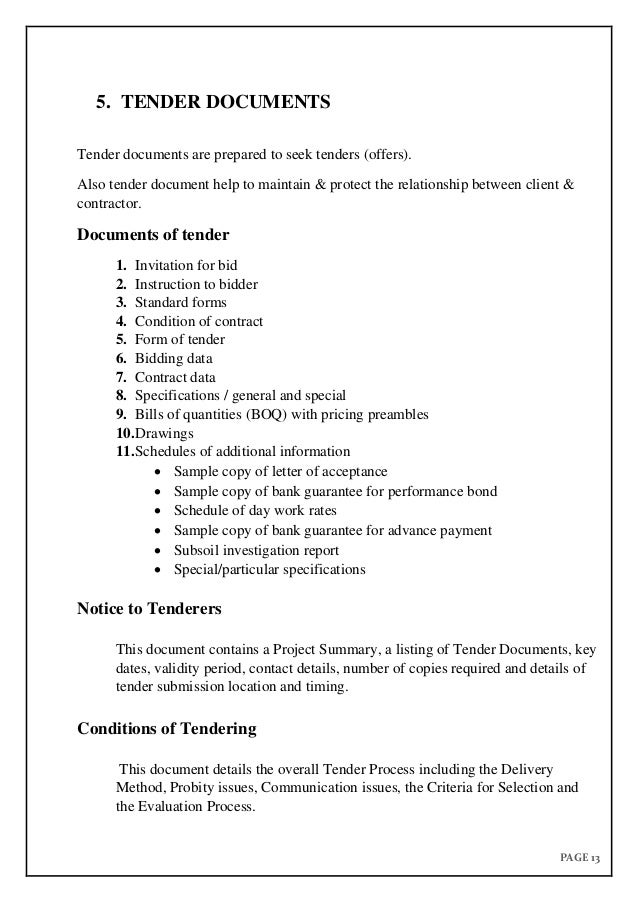
A tender can be said as an offer to do work or supply goods at a fixed price. Initiating step of a tendering process in which qualified contractors are invited to submit sealed bids for construction or for supply of specific and clearly defined goods or services during a specified timeframe. The tender process is designed to ensure that the work to be done for client/government is given out in a fair way. For example in Malaysia, there are a number of policies known as procurement policies which guide government of Malaysia on how to make decisions on which tender to accept. Although price is very important in the decision on which tender or bid to accept, it is not the only factor taken into account.
Once client/government accepts a tender, it is binding on both parties. This means that the person or company that won the tender has to provide the goods or services in the manner agreed to and at the price offered, and client/government must pay the agreed price at the agreed time. In other words, once accepted, a tender is a binding contract.
2.2 Types of tendering
When talk about tendering, it is involved some kind of complicated process and procedure. Before any tendering process can be done, professional team and employer must make sure all necessary tender documents have been prepared, checked and approved. The source of the funding also must have been identified and the project financing put in place. The procedures for subsequent stages should have been established with the express consent of the employer to ensure the tendering process will go smoothly.
What types of tendering that employer want to choose is depends on nature of contract, complexity of the construction, expertise needed and several reasons. But usually for the government project all over the world, is tend to make open tender to ensure the procurement and works to be done in fairly manner without prejudice. As the researcher mention before, open tender is one of the types of tendering that commonly used in this world. Actually there are several types of tender including open tender, selective tender, negotiated tender, serial tender and term tendering.
2.2.1 Open tender
Open tendering is the main tendering procedures employed by both the government and private sector. The client advertises the tender offer in the local newspaper giving detail and key information of the proposed works and inviting interested contractor to tender. In the legal sense such tender notices constitute invitation to treat, a mere request by the employer for suitable contractor to submit their bids or offers.
If the pre-requisite to tendering on the form of possession of the necessary registration has been identified in the tender notice, then the advertisement is directed to only that particular class of the public having the said qualifications. In order to reduce number of enquiries, earnest money is deposited (for private project). Until the receipt of a bone fide tender selected then it will be returned. Although price is very important in the decision on which tender or bid to accept, it is not the only factor taken into account. Client does not bind to accept the lowest or any offer. The advantages and disadvantages of open tender are stated below:
Advantages
Disadvantages
It allows any interested contractor to tender. Therefore it gives opportunity for an unknown contractor to compete for the work.
The tender list can be long as too many contractors tendering for one job.
Allowing the tender list to be made without bias. Client will obtain the bargain possible. No favouritism in selecting contractors.
Uneconomic use of source.
Ensuring good competition not obliged to accept any offers.
Public accountability may be questioned if the lowest offer is not accepted.
Types Of Tendering
Traditional method of tendering, familiar to all sector of the engineering and construction industry.
Does not attract reputable and established contractor unless they are forced to, due to lack of work.
Selective tender
Selective tendering is the one alternatives developed to address the limitations of the open tendering procedure. In this method, a short list of contractor is drawn up and they are invited to submit tenders. The purpose of the elective tendering are to improve the quality of the bids received, to ensure that contractors with the necessary experience and competence are given the opportunity to submit the necessary bids, due to urgency work involved, for specific reasons of the employer, eg security reasons in government projects. etc. and to make the tendering procedure more manageable and less a burden on the parties involved. Such list may be prepared through recommendation from the Client’s professional adviser whom have knowledge of the Contractors undertaking the work in the past or advertisement through the newspaper (prequalification). The advantages and disadvantages of the selective tendering are stated below.
Advantages
Disadvantages
Only the competent contactors were invited to tender, then the lowest can be accepted.
Reduces the availability of work for other contractors especially new contractors.
It reduced the cost of tendering (economic use of resources, reduced tender documentation, shorter tender periods, better management of the tender process, etc.)
Tender Price may invariably higher than would have been in open tendering.
Greater chance of collusion.
Tendering period longer because it involved two distinct stages.
Favoritisms may occur in the short listing.
Two Stage Selective Tender
Two stage selective tendering combined elements of competition and negotiation into a formula where the employer could utilize the contractor’s expertise at an early stage of the project cycle so as to maximize innovation, ingenuity and quality and simultaneously optimize cost, time and resource input. A contractor is selected competitively early in the design process. The tender documents contain approximately quantities of the major value items. As design and planning proceed, the final tender is developed from cost and priced data supplied with the initial tender. Two stage selective tendering was very popular in developed countries. It was different from selective tendering because has two (2) distinct stages namely:
Selection of suitable contractor
This involves the selection of a suitable contractor and the establishment of a level of pricing for subsequent negotiations.
The objective is to select suitable contractor as early as possible is to work together with the professional team and to establish a level of pricing for subsequent negotiation.
The criteria for short listing is normally confined to items such as technical and financial capability, experience in similar works and extent of resources (manpower, plant and equipment).
The pricing document should be flexible enough to cater for adjustment of price fluctuation for the period between two stages and the pricing of the second stage.
In selecting a suitable candidate, a basis for pricing the subsequent second stage should be established accordingly.
Determination of Contract Price
Once a suitable contractor is selected, he will work together with the project team start contributing to the pre contract process in his capacity as unbiased but independent construction expert. This contractor will contribute the following:
Contribution as a Technical Advisor to the Design Process
Practical Skills and Buildability
Minimization of Project Delay
During this stage, a negotiation to reach an agreement on the final contract price is undertaken and the pre contract process is perfected.
If no agreement being reached, the employer has an option to abandon the tendering exercise and re-tender the works using any other tendering procedure.
The application of two stage selective tendering might be appropriate where the works are a very complicated nature, where at the time of selection of the contractor, the magnitude of the work may not be known with sufficient certainty and where it is an essential pre-requisite for works to be finished by an early completion date. Table below are some advantages and disadvantage of two stages selective tendering.
Advantages
Disadvantages
Benefit of the contractor’s expertise in buildability, specialist knowledge in proprietry systems, project scheduling, etc resulting in value for money.
Its application requires a high level of familiarity and commitment on the part of employers and contractors.
Early commencement of work at site even when the magnitude of the works is not known with sufficient certainty at the time of site possession.
Owing to a relatively smaller element of competition, but on the other hand higher negotiations content, the tender process is relatively more expensive and longer than other common procedures.
Savings of time due to the overlap of the design and tendering stage.
Should the second stage be deadlocked or result in no acceptable agreement being reached, the tender process has to be initiated all over again, albeit, through a different route. This incurs a time and cost penalty to the project as a whole.
The procedure utilizes the best aspects of both competition and negotiation to arrive at the most favourable arrangement at an optimum firm price before work commences.
This procedures requires a high level of commitment, integrity and good faith on the part of both sides which sadly is usually lacking, hence the apparent failures encountered to date.
Since the contractor is part of the project team at a very stage of the project, this results in better communication and information flow.
Generally there will be fewer claims and disputes in the post contract award stage due to the contractor’s involvement at the design / pre contract stage. Experience has shows that the contractor has a clearer understanding of the requirements and a better appreciation of the intricacies of the design and contract documentations.
Negotiation Tender
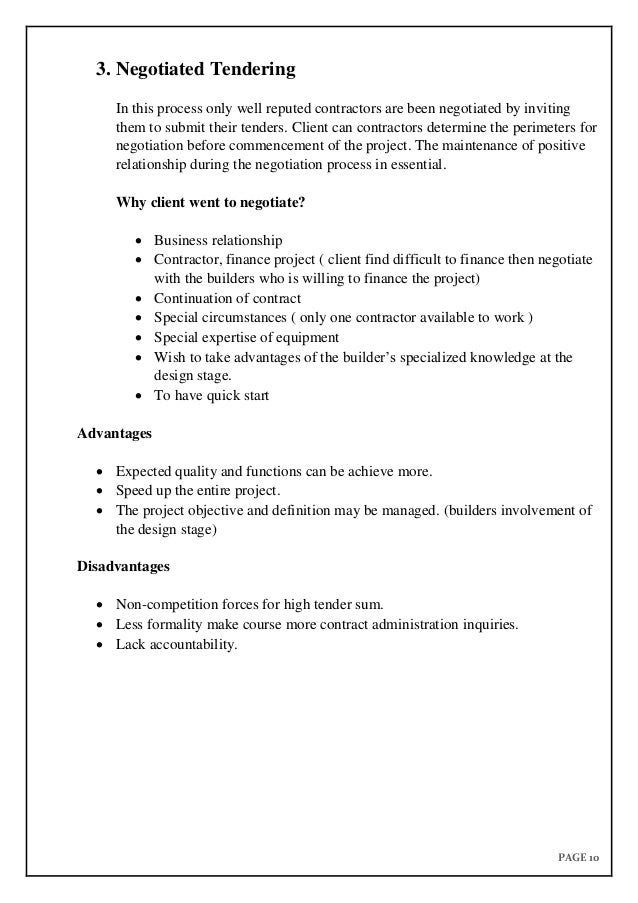
Negotiation tendering is extensively used in the engineering and construction industry commencing from tendering till dispute resolutions, i.e. under the styles of pre-contract negotiations and post contract negotiations. Usually with single contractor but may be up to three contractors. Negotiation process involves are as follows:
Identification by the employer of a suitable contractor to negotiate with. The contractor can be selected either from the employer’s own list of preferences or on the advice of the professional team.
The contractor being apprised of the workscope.
Define Serial Tendering In Bangladesh
The selected contractor is issued with details such as the scope of work involved, relevant drawings, design and /or information to enable him to appreciate the extents of obligations and the employer’s actual needs. Some employers prepare and issue to the contractor proper tender documents inclusive of a nominated bills of quantities to assist contractor in pricing the works for the forthcoming negotiations. Negotiations can be applied to the following type of contract:

In Partnering type of contracts under the so called win-win formula.
Where the employer has a long term business relationship with the contractor.
In situations where the parties are in a relationships of holding and subsidiary companies.
Where the contractor is involved in the financing of the project.
In situations where the employer finds it advantages to employ the same contractor to continue an initial or existing contract for the new works
Where there is a pressing need to have a very early start of work on the site and to complete the works on a fast tract basis.
In special circumstances e.g. Security reasons, emergencies etc where it is expedient to secure the services of a particular contractor only.
Where there is only a single contractor who is the only one available or with ether the special skill or resources to carry out the particular works.
The employer’s resources are either limited or constrained thereby making the use of the other tendering impractical.
Advantages
Disadvantages
Only reputable contractor are invited for negotiation.
The cost work is likely higher than competitive tender.
The Contractor can contribute his expertise during design stage.
Reduces the availability of work for other contractors.
Early Commencement of work on site. It shortens the period involved in appointing the contractor.
Should the negotiations be deadlock or prove eventually unsuccessful, this causes wastage of valuable resources on both sides and loss of time for the employer, thereby delaying the overall selection of suitable contractor.
Reduce risk of failure
Best alternatives for the employer to adopt is special circumstances such as emergencies, security reasons and etc.
Experience has shows that contracts let out this basis result in fewer disputes and claims during the construction stage.
Term Tender
Term tendering normally used on major maintenance projects. It may be awarded to a contractor to cover a range of different buildings in different locations. It is often limited to a fixed time scale, although the needs of the client may often require this to be extended. It is like a standing offer to undertake a loosely defined extends of work usually within a fixed time period. The type of work is usually specified and priced in a schedule of rates. The contractor will initially be offered the work to cover a number of different trades usually on the basis of prices contained in a schedule prepared by the client.Where the client supplies the rates for the work, the contractors are given the option of quoting a percentage addition or deduction from these rates depending upon their desire to win the project. The contractor offering the most advantageous percentage to the client will then be awarded the contract. An indication of the amount of work expected over the specified period of time will assist the contractors in the consideration of the percentage to be quoted.
2.3 Conventional Tendering Process
As the researcher mentioned before, this chapter will focus on conventional tender while the next chapter will focus on electronic tendering. Therefore readers will see clearly background on conventional tendering and electronic tendering. Conventional tendering process will involve pre-tender stage, tender advertisement stage, closing of tender, tender opening process, tender evaluation process and finally tender award.
Define Serial Tendering System
3ds emulator for r4. 2.3.1 Pre-tender Stage
At pre-tender stage, when the clients have an idea, client will appoint consultant to discuss further about the project. Consultant will do their job, advising, managing the tender and contract, and also transfer the idea into the drawing. At this stage client and consultants will brainstorming about the scope, time to complete and budget that client willing to allocate. Researcher believes that pre-tender stage is most crucial matter because it will initiate the next step of a project. If the pre-tender stage is failed, the project will not successfully complete.
2.3.2 Tender Advertisement
Tender advertisement also called tender notice. The conventional tender notice will advertise in local newspaper. In tender notice, basic requirement should be appearing are:
Title of the project.
Class of contractor, head and subhead needed.
Location, date, and time to obtain the tender document.
Fees for tender document.
Location, date and time for submission of tender doc.
2.3.3 Closing of Tender
In tender notice will mention the time and date of tender closing process. If the contractors fail to submit their bids within specific time and date, it considers the contractors refuse to bid for the tender. At that time also tender validity period is started. At this period, contractors can withdraw back their bids if they are no more interested to fight for the tender. Consultant use this period to make assessment and evaluation each of the offers.
2.3.4 Tender Opening and Evaluation Process
Quantity surveyors usually will handle tender opening process. In order to preserve the integrity of the competitive process, it is imperative that the evaluation of proposals is undertaken objectively, consistently and without bias towards particular suppliers. Tenders are usually evaluated against a pre-determined set of criteria. The evaluation of the tenders shall be prepared the soonest possible after the tender opening. A report prepared by the Quantity Surveyor will describe the findings of the said evaluation and it will be supported by tables and graphs. In the end, the Quantity Surveyor will recommend which tenderer, who in his opinion, is the most suitable to undertake to execute the project.
2.3.5 Tender Award
An evaluation team will examine each tender received and make recommendations as to which tender represents best value for money. Once the contract has been awarded, both the successful and unsuccessful tenderers will be notified. Once the final decision has been made on the tender award, the tender administrator creates the tender results notification which is in letter form, and then sent to all participating contractors.